

7 Smart Ways to Choose a Reliable Solar Water Pump in Pakistan
Learn how to choose a solar water pump in Pakistan. Compare pump types, calculate flow and head, estimate system requirements, and avoid costly buying mistakes.
Introduction
A solar water pump can supply water for a home, farm, livestock operation or commercial facility without relying entirely on grid electricity or diesel fuel. But buying the wrong system can leave you with insufficient water, unnecessary equipment costs or a pump that struggles to operate at the required pressure.
The most important buying decision is not simply whether to purchase a 1 HP, 3 HP or 5 HP pump. It is whether the complete system can deliver the required quantity of water against the actual pumping head, using the available solar power.
What Is a Solar Water Pump?
A solar water pump is a pumping system that uses electricity generated by photovoltaic solar panels to operate a motor and move water from a source to a required destination.
A typical system includes solar panels, a pump controller or variable frequency drive (VFD), an electric motor, a pump assembly, electrical protection and the necessary pipes and fittings. A water storage tank may also be included.
Unlike a conventional grid-powered pump, a solar-powered system can operate using solar electricity during daylight hours. Depending on its configuration, it may also use grid or generator backup. Batteries are optional rather than a universal requirement.
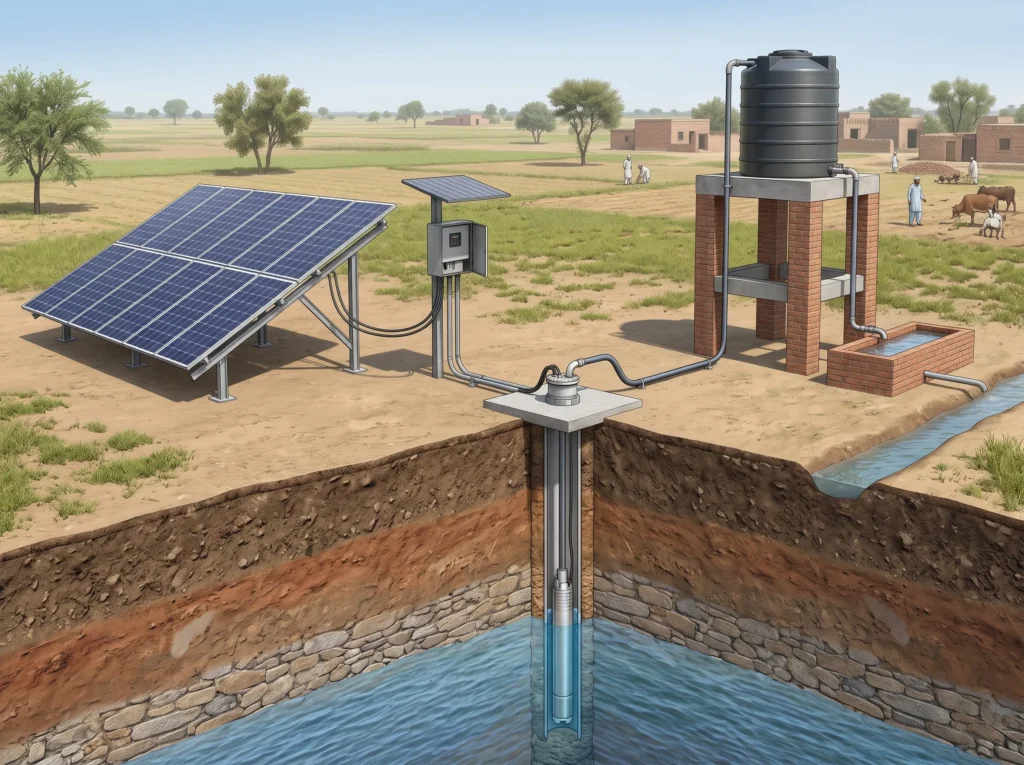
How does a solar water pump work?
The process has five main stages:
The motor drives the pump, which moves water through the delivery pipe.
The actual water output varies with sunlight, pump speed, total dynamic head, the pump’s performance curve and the condition of the water source. A system’s maximum advertised capacity should not be interpreted as its guaranteed output throughout the day.
Need A Quotation?
Get a customized solar water pump solution for your farm, business or home.
Types of Solar Water Pumps
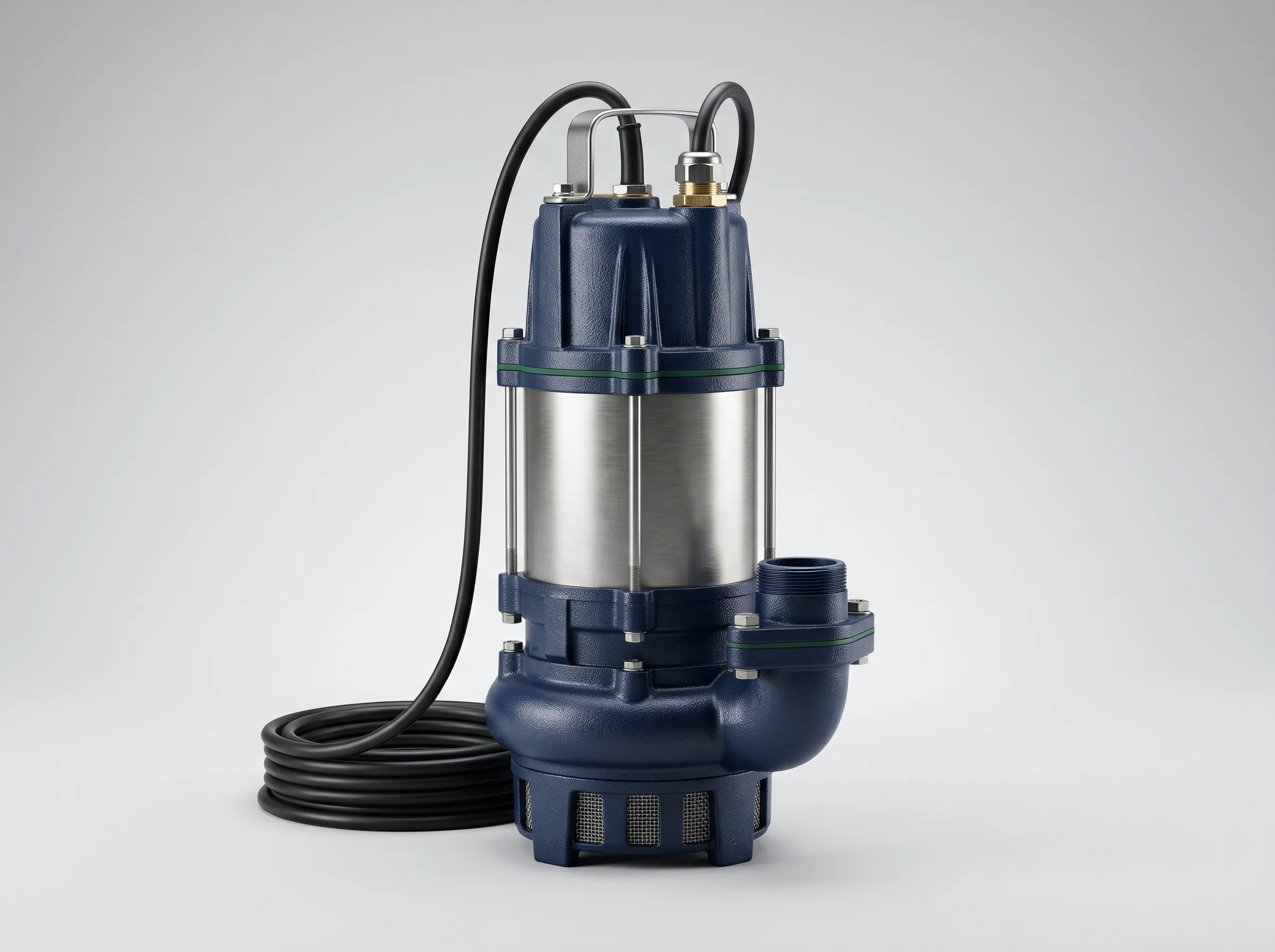
Submersible Solar Water Pump
Installed underwater, ideal for deep boreholes, tubewells and agricultural water supply.
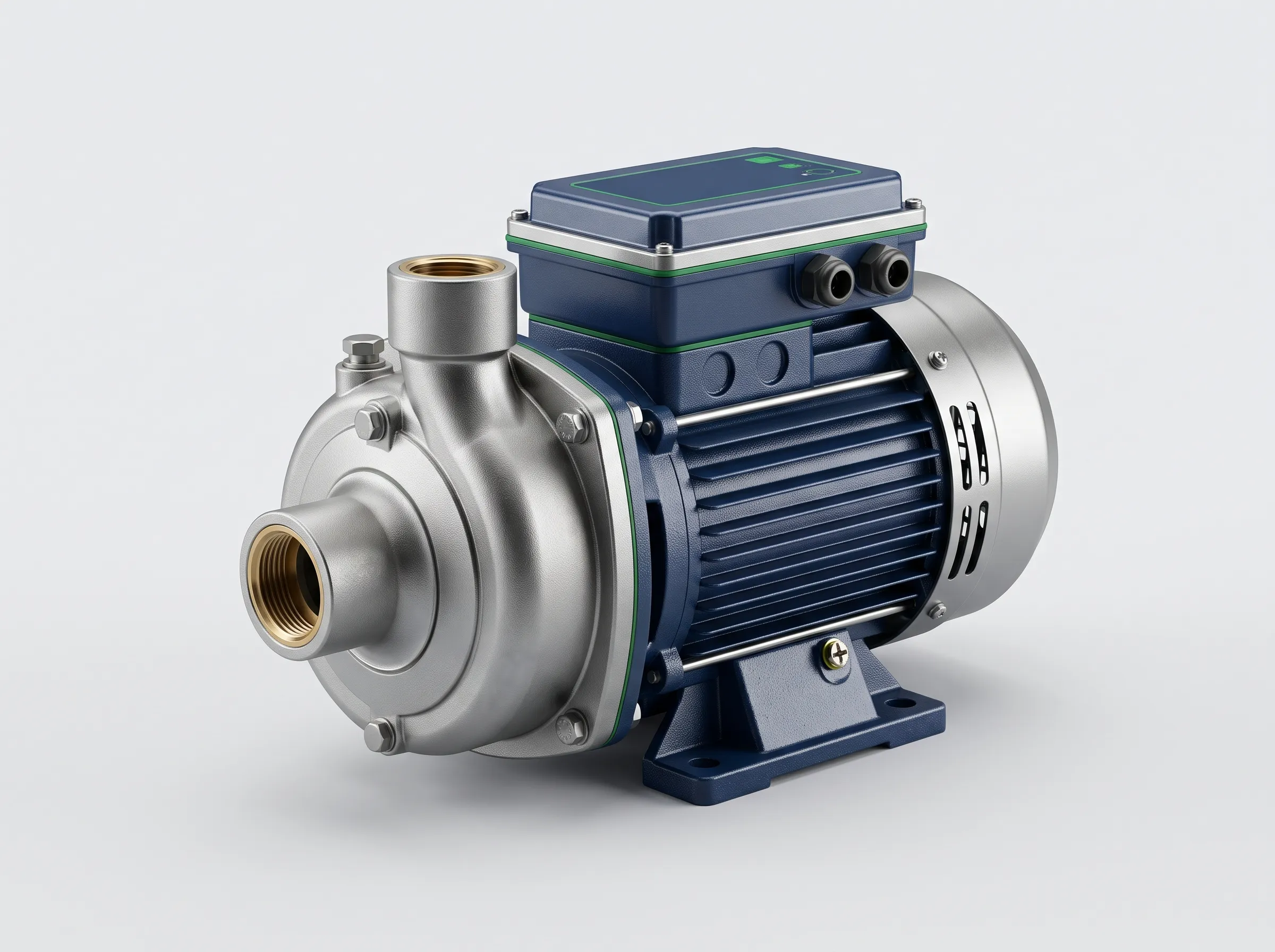
Surface Solar Water Pump
Installed above ground, suitable for shallow wells, ponds, canals and water transfer.
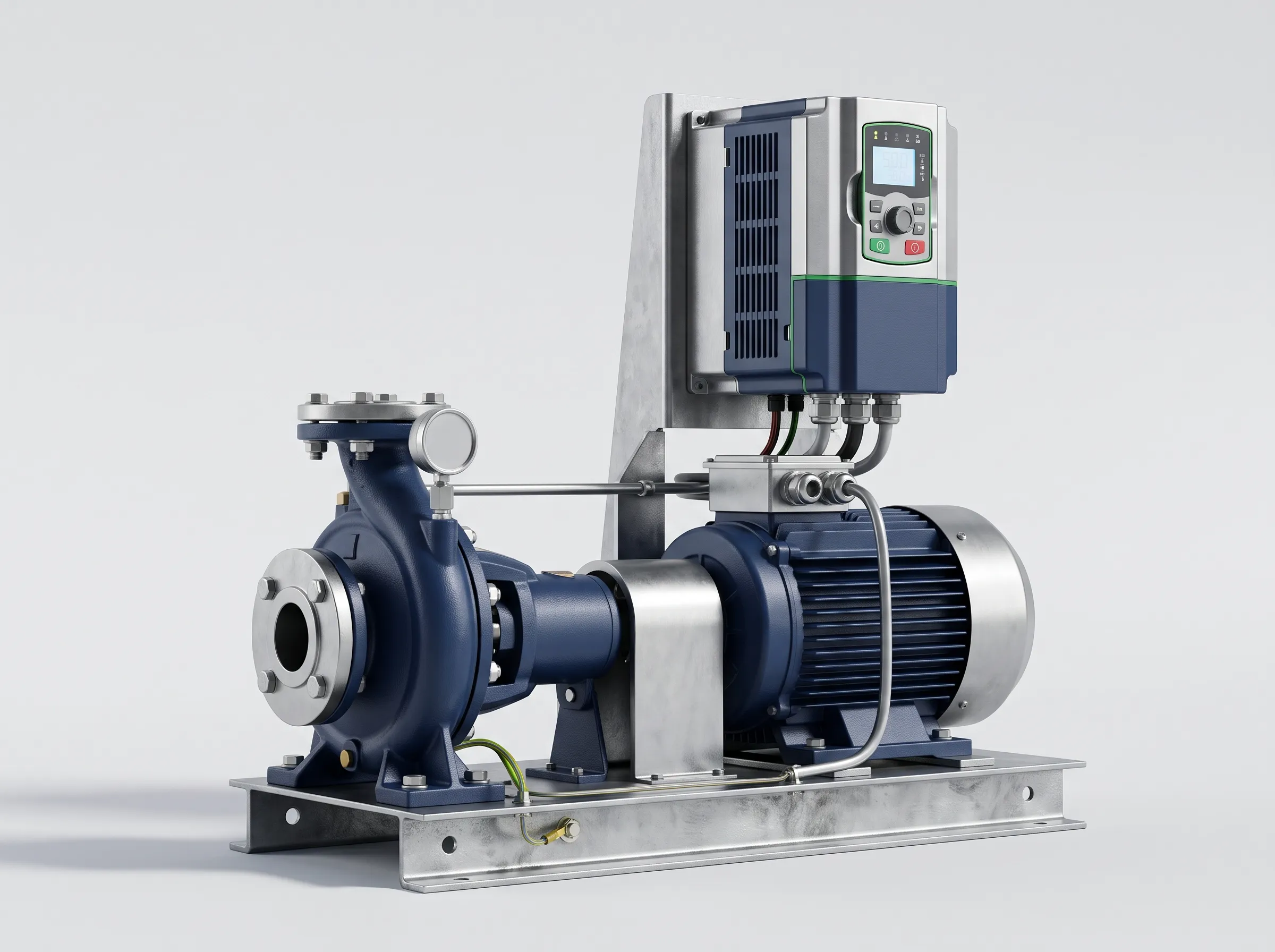
AC Solar Water Pump
Uses an AC motor with a compatible solar VFD, suitable for agricultural irrigation and large-scale water pumping.
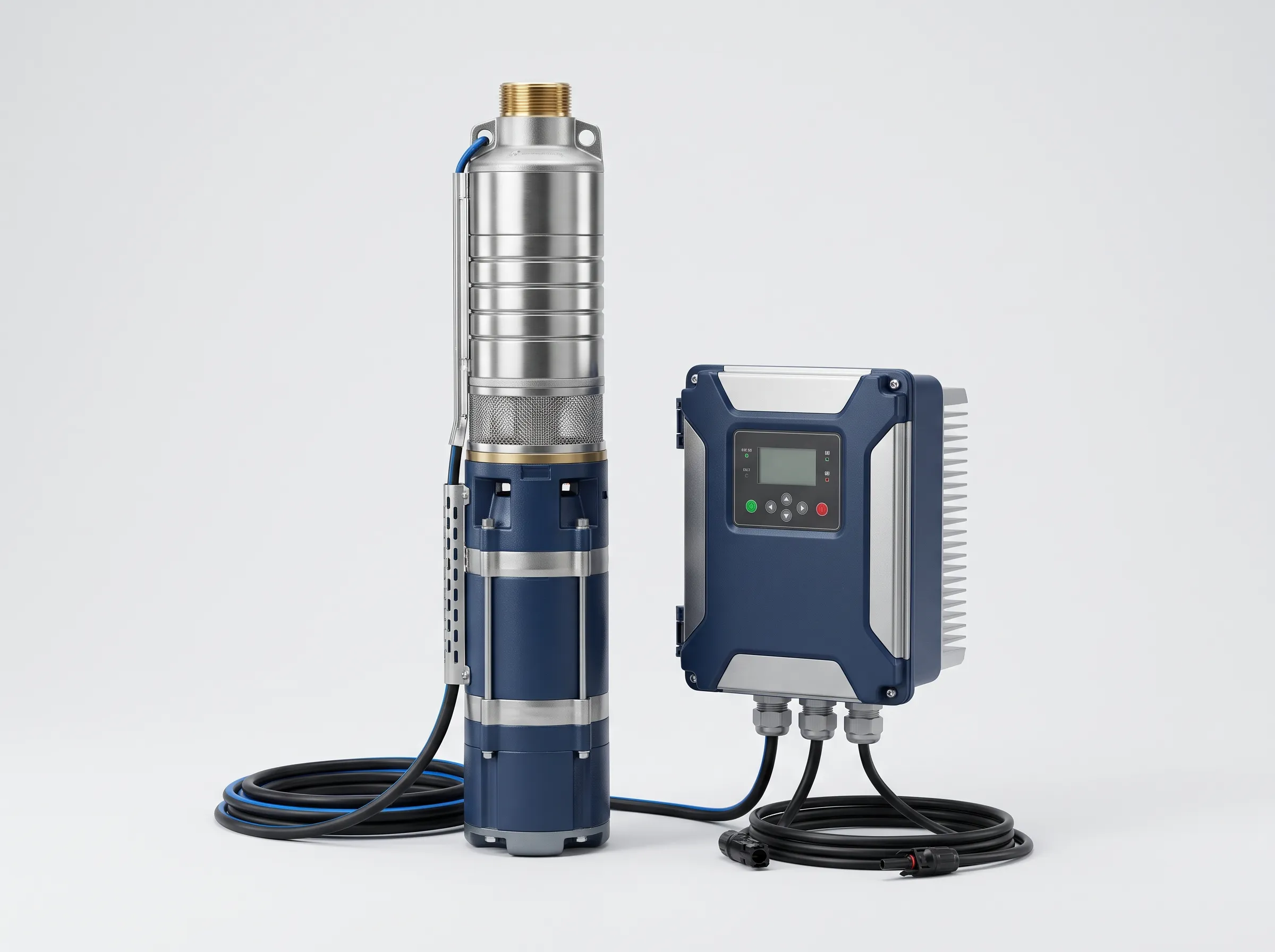
DC Solar Water Pump
Runs on DC power from solar panels through a compatible controller, ideal for small farms, livestock watering and remote water supply.
Surface vs submersible solar water pumps
A surface pump sits outside the water source and draws or transfers water through an inlet. It is convenient where the source is accessible and the suction arrangement is suitable.
A submersible pump operates below the water level. It is generally the more appropriate arrangement for deep boreholes because it pushes water upwards rather than depending on a surface pump’s suction capability.
A conventional surface centrifugal pump cannot simply be placed far above a deep water source and expected to lift water from any depth. Atmospheric pressure, suction-line losses and the pump design limit practical suction lift. Always follow the manufacturer’s specified operating limits.
AC vs DC solar water pumps
An AC pump paired with a compatible solar VFD can be useful when an existing AC motor is to be retained or when grid or generator backup is required. However, not every AC motor is compatible with every solar drive.
A DC solar pump can simplify the electrical arrangement in an appropriately designed standalone system. Its practical advantages depend on the motor and controller, replacement-part availability and the application’s duty cycle.
Which should you choose? Consider an AC pump with a solar VFD when compatibility with an existing installation or backup power is important. Consider a dedicated DC solar pump when the selected model meets the duty requirement and its controller, protection and servicing arrangements are suitable. Neither configuration is universally more efficient in every installation.
Comparison of Solar Water Pump Types
Choosing the right solar water pump depends on water depth, required flow rate, pumping distance and electrical configuration. Compare the main pump options below to identify the type that best suits your water supply or irrigation needs.
| Feature | Submersible Pump Installed underwater | Surface Pump Installed above ground | AC Solar Pump AC motor configuration | DC Solar Pump DC motor configuration |
|---|---|---|---|---|
| Installation | Installed inside the water source. | Installed above ground, near the water source. | Installation depends on the pump design. | Installation depends on the pump design. |
| Suitable Water Sources | Deep boreholes and agricultural tubewells. | Shallow wells, ponds, canals and storage tanks. | Water sources compatible with the selected pump. | Water sources compatible with the selected pump. |
| Power Configuration | Available with compatible AC or DC motors. | Available with compatible AC or DC motors. | Uses an AC motor, typically with a compatible solar drive. | Uses a DC motor with a compatible controller. |
| Common Applications | Agricultural tubewells, deep-water extraction and groundwater supply. | Shallow-water pumping, water transfer and irrigation. | Larger irrigation and water-supply systems, depending on capacity. | Small farms, livestock watering and remote water supply. |
| Main Advantage | Suitable for lifting water from deep sources. | Accessible for inspection and maintenance. | Can accommodate higher-capacity pumping requirements. | Can suit compact, appropriately sized solar systems. |
| Key Consideration | Check borehole diameter, pumping depth and water level. | Check suction lift, pipe losses and installation conditions. | Check drive compatibility, motor ratings and electrical requirements. | Check controller compatibility, motor ratings and solar input. |
Swipe horizontally to compare all pump types.
Before selecting a solar water pump, calculate the required flow rate and total dynamic head (TDH). Also consider daily water demand, available solar capacity, water quality and controller compatibility to choose a reliable system.
How to Size a Solar Water Pump Correctly
The three principal sizing inputs are:
Daily water requirement.
Total dynamic head (TDH).
Available solar energy during the intended pumping period.
The selected pump must meet the required flow at the calculated head. Only then should the supplier finalise the motor, controller and PV array. Manufacturer pump curves and application-specific sizing tools support this process.
Calculate your daily water requirement
Start with the volume of water that must be delivered each day.
For a home, estimate consumption and storage needs. For livestock, calculate the herd’s daily water demand using locally appropriate animal-water requirements. For irrigation, account for crop water demand, irrigated area, irrigation method, application efficiency and the number of operating days.
Calculate total dynamic head
Total dynamic head represents the total energy per unit weight that the pump must provide to move water through the system at the required flow.
A practical calculation considers:
Static lift: The vertical difference between the source’s water level and the delivery point.
Drawdown: The additional lowering of the water level while the well is being pumped.
Delivery head or pressure: The head needed at the outlet, tank or irrigation system.
Friction losses: Energy lost as water moves through pipes, bends, valves, filters and fittings.
For a simple open-source-to-open-tank installation, a preliminary relationship is:
The exact calculation depends on the system arrangement. If a pressurized outlet is required, its pressure requirement must be included as an equivalent head. For an open tank, the difference between the source and destination water surfaces is the relevant static elevation difference.
Select the pump from its performance curve
A pump’s performance curve shows the relationship between flow rate and head for a particular pump and operating speed.
Do not select a pump merely because its maximum head exceeds the calculated TDH. Maximum head is commonly associated with very low or zero discharge, not the desired operating flow.
Instead, identify the required duty point—for example, 1,000 litres per hour at 34 metres—and check whether the proposed pump can deliver that flow at the specified head. Confirm that the operating point is within the manufacturer’s recommended range.
Match the solar array and controller
The PV array must supply sufficient power over the expected operating conditions, and the controller must be electrically compatible with both the array and the motor.
The supplier should verify:
PV array power and expected site conditions.
Array open-circuit voltage and operating voltage.
Controller’s permitted DC voltage and current.
Motor rated power, voltage, phase and current.
Starting and variable-speed requirements.
Required protection and environmental ratings.
A rough PV power estimate can be a starting point, but there is no universally correct multiplier for every motor and installation. The final array should be based on the pump manufacturer’s sizing guidance, local solar conditions and the required daily water production.
Decide how to manage water when the sun is unavailable
Solar pumping output varies with sunlight, so the system design should include a plan for periods when pumping is reduced or unavailable.
A storage tank or reservoir can store water pumped during the day for later use. Grid or generator backup may be appropriate when the application requires greater operating flexibility. Batteries can provide electrical storage in suitable designs, but they add cost, conversion losses and maintenance requirements.
For many water-supply applications, storing water rather than electricity is worth evaluating first.
How Much Does a Solar Water Pump Cost in Pakistan?
The price of a solar water pump system in Pakistan depends on the pump model, motor power, required head and flow, PV array, controller, structure, cabling, protection equipment and installation work.
A pump-only price is not directly comparable with a turnkey quotation that includes panels, mounting, wiring, installation and commissioning. Publicly listed prices can also differ in scope and date, so they should be treated as indicative until the supplier provides a current, itemised quotation.
Ask the supplier to separate:
Pump and motor.
Solar panels and mounting structure.
Solar controller or VFD.
Electrical cables, isolators, protection and earthing.
Pipework, fittings, valves and level sensors.
Installation, commissioning and performance verification.
Warranty coverage, exclusions and after-sales service.
For a fair comparison, ask every supplier to quote against the same required flow and TDH. A lower-priced system is not necessarily better value if it delivers less water or excludes necessary installation components.
Can government support reduce the cost?
Potential agricultural support programmes should be checked against current official eligibility rules rather than assumed to be available to every buyer. The Punjab Agriculture Department publishes information on initiatives involving solar systems for high-efficiency irrigation and other agricultural interventions. Programme eligibility, geographical coverage, cost-sharing arrangements and application windows can change.
Government of the Punjab
The Story
A small river named Duden flows by their place and supplies it with the necessary regelialia. It is a paradise
what we do
Popular Features
The beginners’ introductory course has one hour of coaching and an hour of
practice in the morning with an extremely nominal
Best routes
Our lesson are available for both beginner advanced beginners we haves.
Powerful solutions
Our lesson are available for both beginner advanced beginners we haves.
Leaders of tomorrow
Our lesson are available for both beginner advanced beginners we haves.
Yours to discover
Our lesson are available for both beginner advanced beginners we haves.
Staffing solutions
Our lesson are available for both beginner advanced beginners we haves.
Best routes
Our lesson are available for both beginner advanced beginners we haves.
Active Attorneys
Successful Cases
Cost for clients
Happy Clients
our news
Latest News
The beginners’ introductory course has one hour of coaching and an hour of
practice in the morning with an extremely nominal